Kiri Viharaya
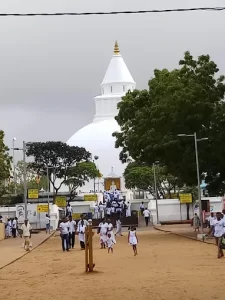
The ancient Kiri Viharaya of Kataragama is a large temple mentioned in texts such as the Sarasangraha and Saddharmarathnakara. The significant changes that occurred in that temple after the arrival of the Portuguese and the Uva Rebellion of 1881 remain a divine mystery. According to the design of the city of Kataragama, the royal palace and its associated structures were located on the southern bank of the Menik Ganga, in front of Wedahitikanda, while the Buddhist sacred sites were situated on the northern bank, in the area known as the Kihiri Garden. The general population resided in Katagamuwa and Detagamuwa. When the area later became forested and depopulated, the remaining few people settled in the land of the sacred sites.
The ancient Kiri Viharaya of Kataragama, along with other historic buildings, was set on fire and destroyed by the Portuguese, who arrived in Kataragama in 1505 A.D., after burning hundreds of thousands of houses in the coastal regions and killing everyone they encountered. They looted and destroyed all valuable possessions. It is said that the flames which consumed the monks and nobles who perished in the Kataragama temple on that day still symbolically burn in Portugal to this day.
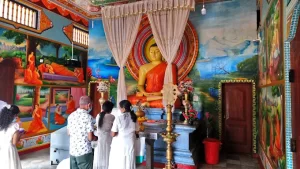
After the loss of the grand Kiri Vihara, which was among the most magnificent structures in Sri Lanka at the time, in 1731 A.D., Chandajoti Nayaka Thero, a disciple of the southern Sangha leader Vehella Dhammadinna Thero who held the Sri Pada lineage, was appointed as the leader of Kataragama. In 1760 A.D.,a small monastery was constructed near the Bodhi tree under Thero’s direction.The Buddha statue placed there led some people to call it a Perumal Kovil (Hindu Shrine).
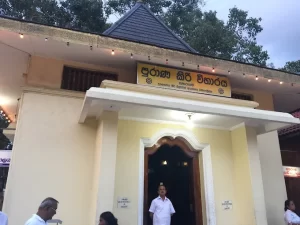
Later, in 1868 A.D., this monastery was partially expanded and restored by Medhankara Thero of Kirineliya. Subsequently, in 1903 A.D., Polommaruwe Piyarathana Thero, who became the Sanghanayaka (chief monk) of Kataragama, further enlarged and completed the shrine, transforming it into a fully completed Buddhist monastery building.
When it was under the care of a person named Appuhamy, the temple came to be commonly known as “Appuhamy Kovil.” After the well-known Kataragama murder case, Dr. Paul E. Pieris took steps to bring this temple under government administration.